
Industrial maintenance in Bangladesh is changing rapidly. Manufacturing plants, power stations, food processing facilities, textile mills, cement factories, and utility companies are moving away from paper-based maintenance toward digital maintenance management.
As production targets continue to rise, equipment reliability has become a competitive advantage. Every unexpected machine breakdown results in production loss, delayed deliveries, overtime labor, and expensive emergency repairs.
A Computerized Maintenance Management System (CMMS) helps organizations digitize maintenance operations, reduce downtime, improve asset reliability, and increase maintenance team productivity.
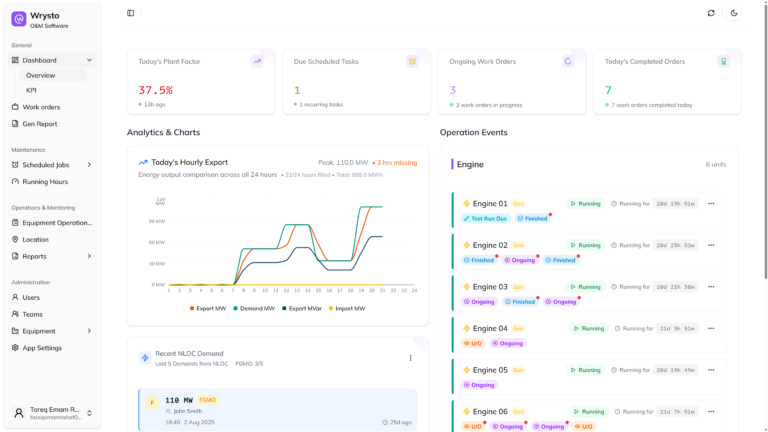
Wrysto is a cloud-based CMMS built specifically for industries that require structured maintenance management, preventive maintenance scheduling, work order control, equipment history, and maintenance reporting.
What is CMMS Software?
A Computerized Maintenance Management System (CMMS) is software designed to help organizations plan, schedule, execute, monitor, and improve maintenance activities.
Instead of managing maintenance using Excel sheets, WhatsApp messages, paper logbooks, or whiteboards, all maintenance data is stored in one centralized platform.
A CMMS allows maintenance teams to:
- Schedule preventive maintenance
- Track equipment history
- Assign work orders
- Monitor technician activities
- Record spare parts usage
- Analyze equipment failures
- Generate maintenance reports
- Improve maintenance planning
Why Bangladeshi Industries Need CMMS Software
Many factories still face common maintenance challenges:
- Unexpected machine failures
- Lost maintenance records
- Reactive maintenance culture
- Poor spare parts visibility
- Manual reporting
- Delayed work orders
- No maintenance KPIs
- Difficulty tracking technician performance
As industries adopt Industry 4.0 practices, these manual systems become bottlenecks.
A CMMS provides the digital foundation needed to manage maintenance efficiently.
Industries That Benefit from CMMS
Wrysto is suitable for:
- Power Plants
- Textile Industries
- Cement Plants
- Steel Mills
- Food & Beverage Manufacturing
- Pharmaceutical Manufacturing
- Chemical Industries
- Paper Mills
- Fertilizer Plants
- Water Treatment Plants
- Oil & Gas Facilities
- Manufacturing Industries
- Utility Companies
- Industrial Facilities
Key Features of Modern CMMS Software
Asset Management
Maintain a complete digital record of every asset.
Information includes:
- Equipment ID
- Serial Number
- Manufacturer
- Installation Date
- Asset Location
- Department
- Specifications
- Equipment Status
Preventive Maintenance Scheduling
Preventive maintenance reduces unexpected failures by scheduling maintenance based on:
- Calendar dates
- Operating hours
- Running cycles
- Meter readings
- Production quantity
Automatic scheduling ensures maintenance is never forgotten.
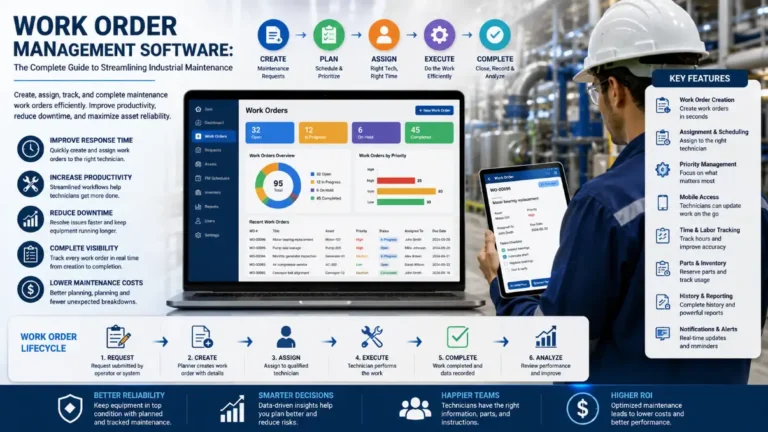
Work Order Management
Maintenance requests become structured work orders containing:
- Job description
- Priority
- Assigned technician
- Due date
- Required spare parts
- Labor hours
- Completion status
Managers can monitor every work order from creation to completion.
Equipment Maintenance History
Every maintenance activity becomes part of the equipment’s permanent history.
Historical records help identify:
- Frequent failures
- High-cost assets
- Root causes
- Reliability trends
- Replacement decisions
Breakdown Maintenance
When equipment fails unexpectedly, maintenance teams can quickly:
- Create emergency work orders
- Assign technicians
- Record failure causes
- Capture downtime
- Document repair actions
This information supports future reliability improvements.
Spare Parts Management
A CMMS helps maintenance stores track:
- Current stock
- Minimum inventory levels
- Spare consumption
- Purchase history
- Vendor information
- Part locations
Proper inventory management reduces repair delays.
Technician Management
Maintenance managers can monitor:
- Assigned jobs
- Completed work
- Labor hours
- Productivity
- Response time
- Skill assignments
This improves workforce planning.
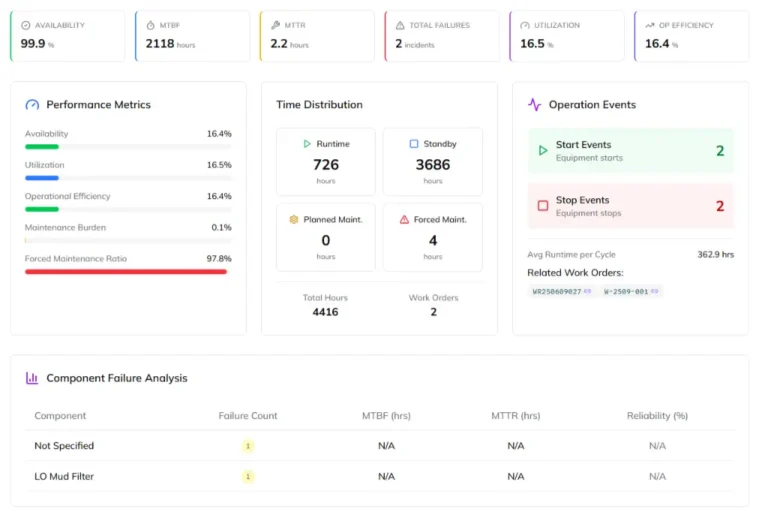
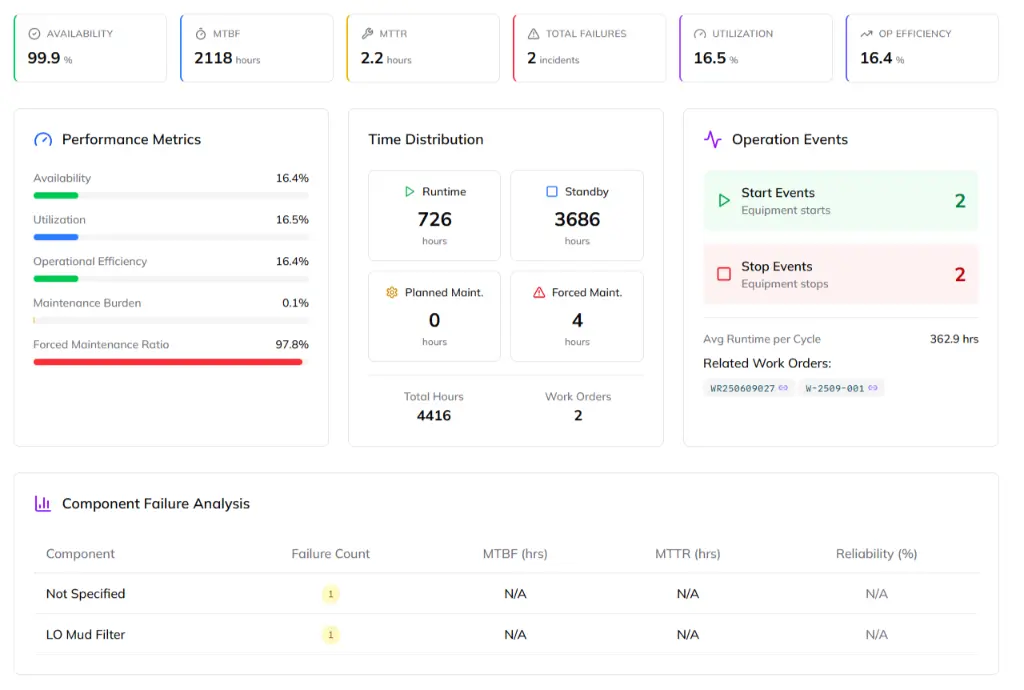
Maintenance Reporting
Modern CMMS software provides dashboards showing:
- Equipment downtime
- Work order completion rate
- Preventive maintenance compliance
- Maintenance backlog
- Mean Time Between Failure (MTBF)
- Mean Time To Repair (MTTR)
- Maintenance cost
- Asset availability
These KPIs support data-driven maintenance decisions.
Benefits of CMMS Software
Reduced Downtime
Scheduled maintenance detects problems before they become failures.
This minimizes production interruptions.
Improved Equipment Reliability
Regular inspections and maintenance increase equipment availability and operational reliability.
Better Maintenance Planning
Maintenance activities become organized instead of reactive.
Managers can prioritize work effectively.
Higher Technician Productivity
Technicians spend less time searching for paperwork and more time completing maintenance tasks.
Better Compliance
Industries with regulatory requirements maintain accurate digital maintenance records for audits.
Lower Maintenance Costs
Planned maintenance is significantly less expensive than emergency repairs.
Organizations also reduce overtime and production losses.
CMMS vs Excel
| Excel | CMMS |
|---|---|
| Manual updates | Automated workflows |
| Separate files | Centralized database |
| Difficult reporting | Real-time dashboards |
| No maintenance history | Complete asset history |
| No scheduling automation | Automatic PM schedules |
| Limited collaboration | Multi-user access |
| Error-prone | Standardized processes |
CMMS vs ERP
ERP systems manage business operations such as:
- Finance
- Procurement
- Human Resources
- Inventory
- Sales
A CMMS specializes in maintenance management.
Wrysto focuses specifically on industrial maintenance while integrating maintenance activities into daily plant operations.
How Wrysto Helps Industries
Wrysto is designed for maintenance-intensive industries.
Key capabilities include:
- Asset Register
- Preventive Maintenance Scheduling
- Breakdown Maintenance
- Work Order Management
- Maintenance Planning
- Equipment History
- Spare Parts Tracking
- Digital Inspection Checklists
- Mobile Maintenance Access
- Maintenance Reporting Dashboard
- KPI Monitoring
- Multi-site Support
- Cloud Access
The platform is built to simplify maintenance processes while improving equipment reliability and operational efficiency.
Choosing the Right CMMS in Bangladesh
Before selecting a CMMS, evaluate:
Ease of Use
Technicians should learn the system quickly.
Cloud-Based Access
Maintenance teams should access data from anywhere.
Preventive Maintenance Features
The software should automate recurring maintenance schedules.
Asset Management
Support for unlimited equipment records and maintenance history.
Reporting
Real-time dashboards and maintenance KPIs.
Scalability
The software should support future growth across multiple facilities.
Local Support
Choose a provider familiar with Bangladeshi industrial operations and maintenance practices.
Best Practices for CMMS Implementation
- Create a complete asset register.
- Standardize equipment naming.
- Define preventive maintenance schedules.
- Train maintenance personnel.
- Digitize maintenance records.
- Monitor KPIs regularly.
- Continuously improve maintenance plans using historical data.
Frequently Asked Questions
What is CMMS software?
A CMMS is software used to manage maintenance operations, equipment history, preventive maintenance, work orders, spare parts, and maintenance reporting.
Is CMMS suitable for small factories?
Yes. Organizations of all sizes can benefit from improved maintenance planning and reduced downtime.
Can CMMS reduce equipment failures?
Yes. Preventive maintenance scheduling identifies potential issues before they become major failures.
What industries use CMMS?
Power plants, manufacturing, textiles, pharmaceuticals, food processing, utilities, chemicals, steel, cement, and many other asset-intensive industries.
Why choose cloud-based CMMS?
Cloud deployment enables real-time access, centralized data, automatic updates, and easier collaboration across maintenance teams.
Conclusion
Maintenance is no longer just a support function—it is a strategic driver of production reliability, operational efficiency, and profitability.
For Bangladeshi industries, adopting a modern CMMS is an investment in fewer breakdowns, better planning, and longer equipment life. Digital maintenance management provides maintenance teams with the visibility and control needed to move from reactive repairs to proactive asset care.
Wrysto brings these capabilities together in a cloud-based platform tailored for industrial environments. By centralizing asset information, automating preventive maintenance, managing work orders, and delivering actionable maintenance insights, organizations can improve reliability while reducing maintenance costs.
Whether you operate a power plant, manufacturing facility, textile mill, or any asset-intensive operation, implementing a CMMS is a practical step toward safer, more efficient, and more reliable maintenance management.